Politics

National

International

Latest Updates

Showing posts with label TECH & SCIENCE. Show all posts

Is that a UFO? Mysterious ring over a Chinese beach [VIDEO]

August 15, 2017


A mysterious black smoke ring hovering for a short time over a beach in northeastern China has stunned the viewers. The UFO-like object was spotted over Jinshitan beach in Dalian, China, on August 12.

Hundreds of beachgoers watched the mysterious black ring before it disappeared from view, but several people captured the strange phenomenon on their mobile phones before it vanished into the clouds.

The footage, shared by Pearl Video, shows beachgoers looking at the mysterious black ring hovering in the sky.


While the recent occurrence might have just been from the playground, UFO experts had earlier spotted a huge spaceship in the sky over France, China and Australia.
In May, footage showing a cigar-shaped flashing object surfaced online and UFO experts believed that the mysterious objects were UFOs. Tyler Glockner, who runs a well-known conspiracy channel Secureteam10 on YouTube, shared the video of the UFOs and said the footage was recorded near Paris. However, he also said that the video could be a hoax as well.
"I've done a bit of digging since I received it, and haven't been able to find a copy of the original video. So I don't know, it could be a full blown hoax." 

Schools not asked to install mobile jammers, but can be installed in school buses to block porn sites: HRD ministry

August 03, 2017


The Central Government has cleared that it hasn't directed public or private schools to install jammers in school premises. However, the HRD ministry cleared that jammers can be installed in buses to prevent access of pornographic sites on the cell phones by anyone.

Rajya Sabha MPs Sarojini Hembram and Wansuk Syeim had raised this issue in the Upper House.
MoS HRD Upendra Kushwaha through his written reply cleared the air about the issue by stating that government hasn't directed public or private schools to install jammers.

The Rajya Sabha MPs had questioned whether government has directed schools, both private and government schools to install jammers in school premises keeping in view the rise of sexual crimes on students and increasing number of reports of porn sites viewed by students.

To this, the minister further stated that there has been only one instance of sexual abuse reported to Central Board of Secondary Education (CBSE) against its affiliated schools in Navi Mumbai in the year 2016.

Already a writ petition was filed in 2013 in the Supreme Court on this issue.

Referring to the additional affidavit filed in Supreme Court, Kushwaha, in his reply, added, "It may not be feasible to install jammers inside the school premises since jammers in schools will block internet access to computers used by children."

Rajya Sabha MPs Hembram and Syeim even asked another question whether there were suggestions to put such jammers in school buses.

To this MoS HRD stated, "In order to prevent access of pornographic sites on the cell phones by the Driver or anyone who is in charge of the children in the buses they can be installed in the buses."

He added that there is a proposal to have one male and female child counselor in every school and special workshops conducted in schools for awareness of sex education can be considered.

As the matter is schedule to came up for hearing on August 8, 2017 in Supreme Court, the ministry refrained to say further stating that the matter is presently subjudice.

Mac users could be at risk, WikiLeaks finds more hacking tools

July 30, 2017


Very recently revealed another set of hacking tools which has been used by the CIA to hack into systems powered by and .

The by WikiLeaks has indicated that 's hacking tools were part of a project called "Imperial" which consisted of 3 different solutions which were supposed to help the agency infiltrate into non-Windows computers and either get control of the devices in the background or steal information from systems without the users noticing it.

Firstly, it was Achilles, a dedicated solution which the CIA had used to integrate Trojan apps into legitimate DMG files which Apple customers have used to install apps on their computers.

The binding tools were created with Bash, WikiLeaks has explained. The tools were capable of removing all traces once the Trojan was deployed on the system, leaving the compromised DMG file entirely clean. This meant that antivirus solutions which were installed after the system was compromised were unable to detect anything wrong with the DMG file. This meant it became pretty impossible to track down how the system was infected.

According to the leaked documents, Achilles was created by the CIA in 2011 and was specifically aimed at Apple Mac OS X Snow Leopard (version 10.6). The second Mac OS X hacking tool is called SeaPea. This tool assisted the CIA in stealing files and information from users without them noticing it was gone.

SeaPea required root access to the device and there is a good chance that the CIA operators used it together with a different malware that could help them get administrator privileges.

So again the hacking tool was created for Mac OS X Snow Leopard (version 10.6), but this time Mac OS X Lion (version 10.7) was also targeted.

And finally, it's the third hacking tool that's called Aeris and which is aimed at portable Linux operating systems, including Debian, CentOS, and Red Hat, but also at FreeBSD and Solaris.

WikiLeaks has stated that Aeris allowed for complex impacts on the targeted systems, as it supported "automated file exfiltration, configurable beacon interval and jitter, stand-alone and Collide-based HTTPS LP support and SMTP protocol support - all with TLS encrypted communications with mutual authentication."

GST impact: Apple cuts iPhone, iPad prices in India

July 01, 2017


A day after the Goods and Services Tax (GST) came into practice, Apple on Saturday reduced the retail prices of iPhones, iPads, Macs and Apple Watch models for its consumers in India.

The Rs 60,000 Apple iPhone 7 (32GB variant) can now be purchased at Rs 56,200. The Rs 70,000 iPhone 7 (128GB) is now available for Rs 65,200 and the Rs 80,000 256GB variant at Rs 74,400.

The base model (32GB) of Apple iPhone 7 Plus is now available at Rs 67,300 as opposed to Rs 72,000 previously.

The 32GB model of iPhone SE (Rs 27,200), being assembled in Bengaluru, will now cost Rs 26,000. The 32GB iPhone 6s (Rs 50,000) is now available at Rs 46,900.

The new prices have taken the basic customs duty (BCD) of 10 per cent into account.

"I think it is a good move ahead of the upcoming festive season. We believe the best way for Apple to increase their share in India is to bridge the gap between affordability and aspirational value of iPhone. Even in the past, they have tasted success with 4S, 5S and iPhone 6 when reduced the price," Tarun Pathak, Senior Analyst, Mobile Devices and Ecosystems at New Delhi-based Counterpoint Research, told IANS.

"By the end of 2017, we believe iPhone 6 and SE can be the flagships through which most users are going to enter the Apple ecosystem for the first time ever," Pathak added.

India has gained a significant place in the Apple scheme of things in the recent past.

Apple CEO Tim Cook recently told Prime Minister Narendra Modi, who was visiting the US, that his company is positive about the production of the iPhone SE in Bengaluru.

According to industry sources, Cook apprised the Prime Minister about the production of Apple's popular iPhone SE model at its Bengaluru facility and the app developers working for Apple.

In May, Apple began the initial production of a small number of iPhone SE in Bengaluru, where it had opened its App Accelerator to provide specialised support for developers earlier this year in March.
Apart from iPhones, Apple also slashed prices of iPads, Macs and Apple Watch.

According to experts, the price drop post-GST will help Apple cement its position in the challenging Indian market. Currently, Apple has 3 per cent market share by volume and 11 per cent by value in the country.

UFO spotted: Father-daughter spot mysterious lights in Germany night sky [VIDEO]

June 27, 2017


A father-daughter duo has reportedly spotted UFOs in the night sky in Germany. They were feeling suspicious about something in the sky which was not visible to the naked eyes.

These mysterious flying objects were not visible till they saw it using the infrared spectrum of their camera, Tyler Glockner from Secureteam 10 stated in a video.

The footage shows lights flashing while making a triangular formation. This finding was pretty mysterious and creepy as the UFOs spotted were not visible to the naked eyes and it's still not clear what it actually was.

The father and daughter wanted to remain anonymous, hence they removed the audio from the footage.

Check out this video to know more:


International Yoga Day 2017: Top 5 smartphone apps for beginners and advanced practitioners

June 20, 2017

Are you one of the hundreds of people who want to take up yoga, but cannot seem to find the right trainer? Well, we have the answer to your dilemma.

There are several apps on both Android-based Google Play and Apple iOS App stores, which offer training modules on yoga that you can follow in the cosy comforts of your home.

Here are our top five handpicked yoga apps (found on both Apple and Google Play), which will help get you get the required information on authentic yoga poses:

Daily Yoga (by Daily Yoga Software Technology Co. Ltd):

Features:

500+ yoga poses with detailed instructions

100+ yoga classes & programs with HD video updated monthly

Multiple choices for session duration varying from 5 - 70 minutes with numerous yoga music available

Scheduled plans for boot camp, body toning, weight loss, strength, flexibility, relaxation, balance, menstruation, body detox, meditation etc. with more than 10 experts
Also supports Chrome cast and Google Fit


Yoga Studio (by Gaiam):


Features:

Best suited for beginners and also advanced yoga practitioners

65 yoga & meditation classes with HD video

Easily customisable; users can also create their own unique HD video classes to share

Library of over 280 poses with detailed advice and instructions


Yoga - Track Yoga (by Eternal Karma Inc.):

Features:

Offers access to a personal yoga instructor. Any yoga-related question such as vinyasa yoga, hatha yoga, yoga breathing, yoga routine, yoga for depression, yoga for runners, yin yoga, ashtanga yoga, core yoga, power yoga, iyengar yoga, pure yoga, yoga fitness, yoga asanas and Baba Ramdev yoga answered within 24 hours.

Yoga instructors teach hatha yoga regularly and are well qualified and experts.

Programs offered include Beginners Mind, Flexibility Series, Full Body Fitness Yoga for Depression and Yoga Workout

Freestyle classes include Stress Relief, Beginner's Mind, Back Pain Relief, Cold & Flu Relief,
Strength Builder, Morning Yoga, Bedtime Yoga, Digestion Booster, Yoga for Balance and more.


Asana Rebel - Yoga & Fitness (by Asana Rebel):

Features:

Ideal for any level - beginners or experienced yogis

Detailed video tutorials for better alignment

Simple workouts ranging from 10 - 30 minutes

More than 400 workout variations that adapt to your fitness level and goals


Yoga tools from Sadhguru (by Isha Foundation):

Features:

Offers specialised training for different aspects, including health, peace of mind, inner exploration

Upa Yoga, which is oriented towards physical and psychological benefits such as enhancing vitality, focus, memory, productivity, stabilize the body, mind and emotions, among others

Detailed practice guidelines

NASA's Kepler space telescope discovers over 200 new planet candidates

June 20, 2017


Washington, June 20: Around 219 new planet candidates were discovered outside our Solar System by US space agency NASA through its Kepler space telescope.

The Kepler spacecraft was launched in 2009. Its mission is to search the nearby region of our galaxy for exoplanets by detecting a transit, or the miniscule drop in a star's brightness that occurs when a planet crosses in front of it.

'Of those, 10 are near-Earth size and orbiting in their star's habitable zone, which is the range of distance from a star where liquid water could pool on the surface of a rocky planet to support life,' Xinhua news cited a NASA statement on Monday.

With the latest release, Kepler has detected a total of 4,034 planet candidates, of which 2,335 have been verified as exoplanets.

Of roughly 50 near-Earth size habitable zone candidates detected by Kepler, more than 30 have been verified.

'This is the most comprehensive and detailed catalog release of candidate exoplanets, which are planets outside our solar system, from Kepler's first four years of data,' NASA said in a statement.
'It's also the final catalog from the spacecraft's view of the patch of sky in the Cygnus constellation,' it said.

According to NASA, few planets were found between the two distinct size groupings of small planets. One is rocky Earth-like bodies and another gaseous planets smaller than Jupiter.

Google launches four new steps to battle terrorism

June 19, 2017


In a bid to fight terrorism, Google has upped efforts to tackle the problem online. The search engine has set in place four new steps to address the issues of terrorism.

The four steps are: better detection of extremist content and faster review, more experts, tougher standards, and early Intervention and expanding counter-extremism work.

'Terrorism is an attack on open societies, and addressing the threat posed by violence and hate is a critical challenge for us all.

'Google and YouTube are committed to being part of the solution. We are working with government, law enforcement and civil society groups to tackle the problem of violent extremism online.
'There should be no place for terrorist content on our services.

'While we and others have worked for years to identify and remove content that violates our policies, the uncomfortable truth is that we, as an industry, must acknowledge that more needs to be done. Now,' Kent Walker, senior vice president and general counsel at Google, in a blogpost.

Detection:

More engineering resources would be in place to apply advanced machine learning research to train new content classifiers.

Google will devote more engineering resources to apply its most advanced machine learning research to train new content classifiers. This would help identify and remove extremist and terrorism-related content more quickly.

The number of independent experts in YouTube's Trusted Flagger programme will also be increased. The programming would be expanded by adding 50 expert NGOs that it will support with operational grants.

Standards:

A very tough stand would be taken on those who violate Google's policy on videos. Videos such that contain inflammatory religious or supremacist content will appear behind an interstitial warning and they will not be monetised, recommended or eligible for comments or user endorsements.


Intervention:

Youtube will expand its role in counter-radicalisation efforts. Its approach targets online advertising to reach potential Islamic State recruits, and redirects them towards anti-terrorist videos that can change their minds about joining.

Expansion:

Google would also work with Facebook, Microsoft and Twitter to establish an international forum to share and develop technology and support smaller companies and accelerate our joint efforts to tackle terrorism online.

PM Modi flags off Kerala's first metro in Kochi

June 17, 2017

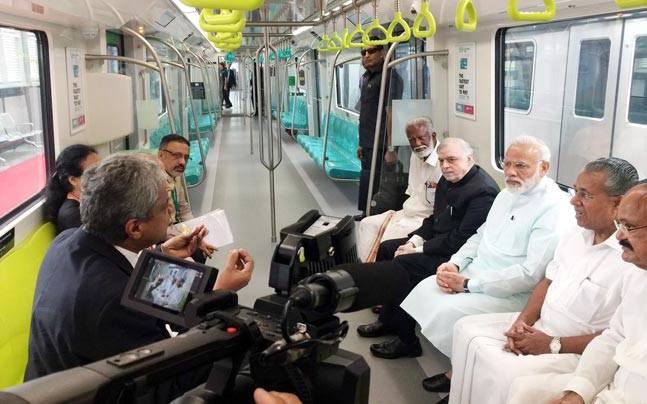
Prime Minister Narendra Modi inaugurated the first phase of Kochi Metro today at Kaloor International Stadium. While delivering the inaugural address, Prime Minister pointed out that his government  had prioritised three key sectors - Urban infrastructure, Railways and Power in the Make in India programme.

"The city's population has been rising steadily, and is expected to reach 23 lakhs by 2021. Therefore, a mass rapid transport system is essential to address the increasing pressure on urban infrastructure.

 This will also contribute to Kochi's economic growth," PM said while stressing on the need for MRTS for urban development.

Prime Minister began his speech in Malayalam and expressed his joy in joining the glorious moments of Kochi for completing the project in record time. PM stated that Kochi Metro would be viewed as a model project in urban public transport system with zero carbon emission level.

"In PRAGATI meetings, I have personally reviewed nearly 175 projects worth more than Rs eight lakh crore. We have resolved bottlenecks and significantly improved the average rate of implementation in these sectors. Now, we are also focusing on next generation infrastructure, which includes logistics, digital and gas. Foreign investment has been invited in this sector. Fifty cities in India are ready to implement metro rail projects," Prime Minister explained how the Make India campaign is transforming Indian cities.

Chief Minister Pinarayi Vijayan who presided metro rail opening ceremony thanked Prime Minister Modi for visiting the state for the inauguration and the support given for the Kochi metro. Pinarayi made it clear that his government would work in tandem with union government ensuring speedy completion of developmental project.

Chief Minister took a dig at people who crafted controversies stating that Kerala wanted to avoid PM's presence in Metro Rail Inauguration.

"Now, some people may be very unhappy as the Prime Minister has come for the inauguration," Pinarayi said.

Union Urban Affairs Minister Venkaiah Naidu too congratulated Kochi Metro Rail Ltd for ensuring best facilities and quality standards. "With metro, Kochi is going to be the smartest City in the country," Minister said.

Before leaving Kochi Prime Minister met Pinarayi Vijayan and cabinet colleagues at naval base and discussed various developmental demands of the state.

Prime Minister who arrived at Southern Naval Command airbase with union Minister for Urban Development Venkaiah Naidu , was welcomed by Governor P. Sathasivam, Chief Minister Pinarayi Vijayan, BJP President Kummanam Rajasekharan and Chief Secretary Nalini Netto.

Prime Minister proceeded to Kaloor by road and enjoyed Kochi metro ride from Palarivattom to Pathadippalam and back to Palarivattom along with Chief Minister, Governor and other dignitaries.

Metro Man E. Sreedharan and Kochi Metro Managing Director Elaias George also accompanied Modi and other dignitaries during the ride.

Modi emerged as a star and impressed the people of Kerala when he came wearing a light blue kurta to match the official colour of Kochi Metro Rail.

13.4 km long Kochi Metro is the fastest metro project in the Country which was completed within four years and ten days. Kochi Metro Phase I, with a project cost of  Rs 51.81 billion, is expected to give a facelift to Kochi, business hub of Kerala.

Kochi Metro will be opened for public from June 19.

PM Modi to ride Kochi Metro, 'Metro man' Shreedharan excluded from dais

June 14, 2017

Prime Minister Narendra Modi will on Saturday travel on a Kochi metro rain when he inaugurates Kerala's first metro, it was announced on Wednesday. But 'Metro man' E. Sreedharan has not been given a seat on the dais.

In the first 25-km phase, trains will run for 13 km between Palarivattom and Aluva. Work is on the remaining section.

Those on the dais will be Modi, Governor P. Sathasivam, Information and Broadcasting Minister M. Venkaiah Naidu and Chief Minister Pinarayi Vijayan.

Elias George, the Managing Director of Kochi Metro Rail Corp, told the media that ' the list of invitees to the dais was prepared and sent to the Prime Minister's Office. The final list is made by the PMO. We have no role in this.'

Reacting to the exclusion of Sreedharan from the dais, P.T. Thomas said: 'This shows the arrogance of the BJP.

'When the foundation stone for Kochi Metro was laid by then Prime Minister Manmohan Singh, none was left out from the dais. This is Kerala's dream project and key people behind this are now asked to sit in the audience. This is totally unfair.'

Kolkata to get India's first underwater Metro

June 11, 2017


Kolkata will soon have an underwater Metro which will pass through tunnels several feet under the Hooghly. The first underwater transportation tunnel of India is ready with the second one nearing completion.

The Kolkata Metro transportation tunnel is unique to India because never before in the history of the country has a tunnel been made under a flowing river.

The tunnel has been constructed 30 metres below riverbed, just a few metres away from the famous Howrah Bridge, built in the last century to connect Howrah and Kolkata.

There aren't even roads that are under a river in India making the Kolkata Metro tunnel a complete technology marvel which will see trains will chugging through it every two and a half minutes.
"It will be connecting two main terminals: Howrah and Sealdah - each of which has a footfall of about 10-12 lakh passengers per day. These type of tunnel-boring machines, which we call 'earth pressure balancing tunnel boring machines', have been used for the first time in Eastern India," said Satish Kumar, Managing Director of Kolkata Metro Rail Corporation Ltd.

Another interesting point is that more than 10 lakh tonne of mud has been dug out for the construction of this tunnel. The tunnel-boring machines were used for the first time in eastern India.
The entire 16.6-kilometre stretch of the first tunnel is ready. The second tunnel is yet to be completed. Of the entire length, 10.8 kms is underground and around one kilometre is underwater..
"For tunnelling below the river, the water tightness, waterproofing, and the design of gaskets were the major challenges, because the tunnel is being constructed for a service of 120 years, so we cannot afford any water leakage during service," said Kumar.

Tunnelling cannot be done for long hence the homework was done for almost an year and then the machines and equipment shifted to the location for final implementation and execution of the plan. The material used gives it immunity to survive quakes in seismic zone 3, in which Kolkata falls.
The use of the standard gauge makes it a unique one. It is the latest technology that has been utilised to ensure that the tracks have sharp curves, keeping in mind that this tunnel passes under a lot of heritage buildings.

The heritage buildings had to be protected, and the work was not supposed to stop even for a day in these buildings.

Puja Shukla, a local resident said, "I think it's a good thing which is happening, because the Metro is the cheapest and the fastest form of transport, used by a large number of people which will also hopefully ease traffic on the surface. This will be very beneficial in connecting people from all over Kolkata."

Here's why Apple's iPhone 8 will disappoint fans

June 09, 2017


Every year, Apple manages to make everyone's heart beat faster with the launch of a new iPhone flagship. This year is going to be special for Apple as it marks the tenth year anniversary of its first iPhone, which calls for a "Tenth Anniversary edition iPhone."

Rumours are rife with details about the iPhone 8, which will be the third variant to iPhone 7s and 7s Plus models this year. The iPhone 8 is expected to bag significant improvements, in terms of both design and specifications. But the Cupertino-based tech titan is likely to face some obstacles on its way to make the new flagship available in abundance.

The iPhone 8 is expected to have several custom-ordered components, making it difficult to mass produce. Citing this, Apple might delay the availability of the iPhone 8 till November and it won't be before FY18 that the company will be able to balance demand and supply, analyst firm RBC Capital Markets wrote in an investor note.

"While we still think Apple launches all 3 models simultaneously in September, the OLED model will see limited availability or delayed availability till mid October/November timeframe," the firm noted. "We are lowering our Sept & Dec-qtr iPhone expectations by 2.5M units each, but expect much of this to be picked up in March-qtr and through FY18."

Apple's extensive upgrades to the iPhone 8 have been associated with the delay in the phone's availability. In March, Barclays analysts Blayne Curtis, Christopher Hemmelgarn, Thomas O'Malley, and Jerry Zhang noted that Apple will launch the anniversary edition iPhone 8 in limited quantities due to complicated manufacturing process and higher ASPs to deliver new features.

Noted Apple analyst Ming-Chi Kuo had also predicted that the iPhone 8 will hit the markets only in early 2018. According to Kuo, the mass production of iPhone 8 will be pushed back to October or November.

Apple is going to launch its most-awaited iPhones in September this year, following its standard practice. The new iPhone 8 is expected to undergo massive design overhaul, feature an OLED display with integrated Touch ID and no home button. The iPhone 8 is also expected to sport wireless charging, and all of these premium features are expected to push the cost to around $1,000.

There's still a long way to go before Apple officially launches its 2017 iPhones, and a lot can change in due course. While analyst predictions are likely to be precise, they're subject to change depending on Apple's development.

NASA's Hubble telescope spots distant Vermin Galaxy

June 07, 2017


NASA's Hubble telescope is known for capturing stunning space images and it captured another snap of a distant galaxy which hides behind a star dubbed HD 107146.

The image portrays a blur of jagged spikes, speckled noise, and weird, clashing colours. The NASA image appears as a smudge to the lower right as it starts aligning with and passes behind the debris of HD 107146, this event is known as transit.


The star is located nearer to us within the Milky Way and is approximately at 90 light-years away from Earth.

In the latest image captured by Hubble, the star appears like a big blob in the middle of the image which is encircled in green. The star can be seen blanketed with yellow, orange and red dots which are a mix of various debris that orbit the star.

The NASA researchers compared the disc of debris surrounding HD 107146 to the cluster of asteroids present in the Kuiper Belt in our Solar system.

"It's an exciting place in the cosmos because of how much the star shares with our own sun, but there's a problem: that big bright patch of nonsense in the lower right corner," a NASA statement said.

A detailed study of this system is possible because of the much more distant galaxy — nicknamed the 'Vermin Galaxy' by some to reflect their annoyance at its presence — as the star passes in front of it. The unusual pairing was first observed in 2004 by Hubble's Advanced Camera for Surveys, and again in 2011 by Hubble's Space Telescope Imaging Spectrograph.

The galaxy will not be fully obscured until around 2020, but interesting science can be done even while the galaxy is only partly obscured. Light from the galaxy will pass through the star's debris disks before reaching our telescopes, allowing us to study the properties of the light and how it changes, and thus infers the characteristics of the disk itself, the researchers said in the statement.

NASA to launch new manned Mars rovers in 2020

June 06, 2017

The new manned version of Mars rovers has been revealed and is likely to be launched by NASA in 2020. Hollywood movies like Tron inspired the researchers to make this new generation of rovers.

The duo, Shanon and Marc Parker, created these rovers in a span of less than five months. The new type of manned Mars rovers will be around 11-feet tall, 13-feet wide and 24-feet long, and will six wheels and an alien design, a report by Pulse Headlines revealed.

The new rovers were built by the Parker brothers from scratch. It is like an SUV which consists of a mock lab where the astronauts can conduct their experiments. The new design of the manned rovers will be revealed soon by NASA.

The inSight (Interior Exploration using Seismic Investigations, Geodesy and Heat Transport) mission is scheduled to be launched on May 5, 2018. It will arrive on the Red Planet on November 28, 2018, and transmit the newly-collected data regarding the emergence of Mars and how it developed over time, to Earth.

Astronauts would be sent to deep space farther than Earth's orbit by 2019 with the help of NASA's Space Launch System.

Also, Earth's conditions and disturbing natural calamities taking place in its ecosystem, like earthquake, would be analysed by the researchers using NASA-ISRO Synthetic Aperture Radar.
Apart from this, other missions are lined up which the space agency will be carrying out in the future like the NASA Asteroid Redirect Mission, which is scheduled to take place in 2021 when a sample will be collected from an asteroid.

The agency also plans to carry out the Psyche mission by 2022, in which the unique, metallic asteroid -- Psyche -- which orbits Sun between Mars and Jupiter will be examined. Researchers believe that this would provide them with more data about how planets are formed, Science World Report revealed.

GSLV Mk3 launch Highlights: India's heaviest rocket puts GSAT-19 satellite in space, ISRO chief says 'historic day'

June 06, 2017


Indian Space Research Organisation (ISRO) launched the country's heaviest rocket - Geosynchronous Satellite Launch Vehicle-Mark III (GSLV-Mk III) - along with a communications satellite GSAT-19 at 5.28 pm on Monday.

The rocket, weighing 640 tonnes and standing 43.43 metres tall, blasted off from the second launch pad at India's rocket port at Satish Dhawan Space Centre in Sriharikota in Andhra Pradesh, around 105 km from Chennai.


Below are the live updates

7: 00 pm: Our immediate task is to improve launch frequency: ISRO chairman AS Kiran Kumar


6: 34 pm: The launch was the culmination of work done over decades. From the information we have received, it's a perfect launch: ISRO chairman A S Kiran Kumar

6: 32 pm: ISRO briefs the media post successful launch of GSLV MK3.

6:10 pm: Director of Space Applications Centre Tapan Misra says IRSO has given birth to a 'Bahubali' today describing the launch of the GSLV Mk III.

6:01 pm: C25 cryogenic stage is the most obedient boy of the ISRO. India has mastered the cryogenic technology and has joined an elite group of nations: ISRO scientist

5:58 pm: We have made a Make in India launch vehicle: ISRO scientist

5: 52 pm: Heartiest congratulations to ISRO on historic launch of GSLV-Mk III. Nation is proud of this significant achievement: President Mukherjee


5: 49 pm: PM Modi says the mission takes India closer to the next generation launch vehicle and satellite capability.


5:45pm: Today is a historic day...I take this opportunity to congratulate the entire team which worked on this project: ISRO Chief Kiran Kumar

5:45 pm: GSAT-19 successfully separated from the launch vehicle.

5:39 pm: Range director says performance of cryogenic engine normal.

5: 28 pm: GSLV Mk III D1 with communication satellite GSAT - 19 takes off from Satish Dhawan Space Centre.

5:26 pm: All main parameters turning green.

5: 21 pm: The rocket's main and bigger cryogenic engine has been developed by space scientists indigenously. It will help India get a greater share of the multi-billion dollar global space market and reduce dependency on international launching vehicles.

5:10 pm: Mission directors gives clearance for launch

5:09 pm: Watch live streaming below

5:07 pm: The rocket will carry a 3,136-kg GSAT-19 communications satellite - the heaviest to be lifted by an Indian rocket till date - to an altitude of around 179km above the Earth after just over 16 minutes into the flight

4:55 pm: Live streaming starts

4: 20 pm: ISRO will broadcast the launch of the rocket on its website. You can watch it here


4: 15 pm: The countdown of 25 hours and 30 minutes began at 3.58 pm on Sunday.

GSLV Mark III Rocket Launch a Great Milestone: ISRO Ex-Chairman

June 04, 2017

The heavy-lift GSLV Mark III rocket, slated to be launched by space agency ISRO on Monday, would open up opportunities for India to launch 4-ton class of satellites, according to a senior space scientist.

The launch of the first developmental flight of the rocket is a 'great milestone' as ISRO is almost doubling the capacity to launch from 2.2-2.3 tons to 3.5-4 tons, former ISRO Chairman K Radhakrishnan said.

Today if India has to launch communication satellites beyond 2.3 tons, we have to go abroad (to launch them). We (will) have self-reliance in launching communication satellites (once GSLV Mk III becomes operational), and also we will be able to attract foreign customers.
"It's rather a simpler vehicle, and a vehicle with better payload fraction. And it's going to be future workhorse vehicle (sic)," he said.

Radhakrishnan was closely associated with the GSLV Mk III programme, approved in 2000, as director of the VSSC (Vikram Sarabhai Space Centre) and then chairman of Indian Space Research Organisation (ISRO). He is now an adviser to the organisation.

"We are getting into the next level of capacity. PSLV is a stable line at the moment. GSLV is better than that. Here we are getting into a vehicle which is going to be more cost-effective," he told PTI in a telephonic interview.

"After a couple of developmental flights to establish, I am sure there will be opportunities for launching even foreign communication satellites," Radhakrishnan said.

GSLV Mk III can launch normal communication satellites that are in the market.

ISRO braces to tame monster rocket that could launch Indians into space

May 28, 2017


An indigenous rocket as heavy as 200 full-grown Asian elephants could well be the one taking "Indians into space from Indian soil" as the country inches closer to joining the big boy's space club.

Standing tall on the rocket port at Sriharikota in Andhra Pradesh is the country's latest rocket called the Geosynchronous Satellite Launch Vehicle Mark III (GSLV Mk- III), the heaviest rocket ever made by India that is capable of carrying the heaviest satellites till now.

The Indian Space Research Organisation (ISRO) enters into a bold new world muscling its way to make its mark in the world's heavy weight multi-billion dollar launch market. "We are pushing ourselves to the limits to ensure that this new fully self-reliant Indian rocket succeeds in its maiden launch," ISRO chairman A S Kiran Kumar said. 

It is the maiden experimental launch of GSLV-Mk III earlier named Launch Vehicle Mark-3, but if all goes on well in a decade or after a slew of at least half a dozen successful launches, this rocket could be India's vehicle of choice to launch "Indians into space, from Indian soil using Indian rockets".

This heavy lift rocket is capable of placing up to 8 tons in a low Earth orbit, enough to carry India's crew module. ISRO has already prepared plans of hoisting a 2-3 member human crew into space as soon as the government gives it a sanction of about 3-4 billion dollars.

If the human venture materialises, India would become only the fourth country after Russia, the US and China to have a human space flight program. Incidentally ISRO asserts the first Indian to go into space could well be a woman!

"In principle, it will be the GSLV Mk-3 or its variant that will be human rated in future," Kumar confirms.

In the intense pre-monsoon heat, India's rocket port is buzzing with feverish activity as engineers from the Indian space agency get set to launch an all new indigenously-made rocket. It is the heaviest fully-functional rocket to reach the launch pad weighing 640 tons or almost 5 times the weight of a fully loaded Jumbo Jet airplane.

The new rocket is capable of carrying satellites of four ton class into the geosynchronous orbit and opens a whole new window through which ISRO can now explore the universe. It is estimated that the new rocket costs a whopping Rs 300 crore but the country would end up saving almost as much when an Indian launcher is used to place New Delhi's communication satellites.

Today India uses the French Ariane-5 rocket launched from Kourou in South America to place its heavy 4 ton class of communication satellites. Kumar asserts that the GSLV-Mk III is a rocket designed and made in India from scratch and hence engineers from ISRO are very keen to tame this new monster in its very first attempt.

Not an easy task, since India's track record suggests that maiden launches of its rockets often end up in failure.

The Polar Satellite Launch Vehicle (PSLV) failed on its maiden launch in 1993 and since then it has had 38 consecutively successful launches and the Geosynchronous Satellite Launch Vehicle Mk-1 (GSLV Mk-1) failed in 2001 and since then it has 11 launches with half of them successful.

Space fairing is a very risky business and all nations the US, France and Japan and even the new private companies have had failures in recent times like the spectacular Falcon-9 rocket in 2016. Hopefully, the GSLV-Mk III will break that jinx.

India already has two operational rockets -- the workhorse PSLV that can hoist satellites of 1.5 tons into space and was the preferred vehicle for India's maiden mission to Moon and Mars.

The second -- the Geosynchronous Satellite Launch Vehicle Mark II can hoist 2 ton class of satellites and because of its repeated failures it was dubbed 'the naughty boy of ISRO'.

Between them, ISRO has done 50 launches and recently even earned a world record by successfully placing 104 satellites in orbit. The new GSLV-Mk III is an all new vehicle designed and developed in India and in 2014 a sub-orbital successful test of this vehicle was conducted to understand how it performs in the atmosphere.

The rocket never went into space but helped test India's future astronaut capsule. It had a dummy cryogenic engine and was a single stage vehicle.

Even though the GSLV-Mk III is 43-m-tall, making it the shortest of the three big Indian rockets, it carries a huge punch as it weighs almost 1.5 times heavier than India's next biggest rocket the GSLV Mk-2 and almost twice as heavy as India's PSLV. This monster rocket has an elegant design and is capable of carrying loads equal to the weight of two sports utility vehicles or SUVs into space.

The massive first stage along with strap-on boosters weighs 610 tons and comprises multiple engines all firing nearly simultaneously. It is the second stage which is all together a new animal for this mammoth rocket, it is a novel Indian cryogenic engine that weighs about 30 tons.

The new cryogenic engine is being tested on a fully functional rocket for the first time and it is the development of this technology that uses liquid oxygen and liquid hydrogen as propellant is what took more than 15 years for Indians to master.

There is a lot of excitement at the rocket port as Kumar says "a whole new rocket and an entirely new class of a high through put satellite system is all set to be launched".

India's 1st under-river metro tunnel to be completed next week in WB

May 28, 2017

The tunnelling work under the Hooghly river, the first such under-river project in the country, to provide metro connectivity between Howrah and Kolkata is slated to be completed next week.

The under-river tunnel is a crucial link for the Railway's 16.6-km long East-West Metro project in Kolkata. The 520-metre twin tunnel, one east-bound and the other west-bound, is built 30 metre below the riverbed.

Commuters between Howrah and Mahakaran metro stations will be under the river for only about a minute when the metro train will pass through the tunnel at a speed of 80 km per hour.

Of the 16.6-km route of the East-West Metro project, the tunneling covers 10.6 km, of which 520 metre under the river.

The under-river tunnel is being built at an expense of Rs 60 cr while the total cost of the East-West Metro project is estimated at around Rs 9,000 crore.

The tunneling work started in April last year and likely to be completed in the river section shortly, a senior Railway ministry official said. The East-West Metro is scheduled to be operational by August, 2019.

The internal diametre of each tunnel is 5.55 metre and the thickness of the wall is 275 milimetre. The distance between the two tunnels is 16.1 metre.

There will be walkways in the tunnels for evacuation of passengers in case of emergency, the official said, adding it was a challenging task to dig tunnel under the river.

For the Railways, besides the tunnel under the Hooghly river, drilling work is going on for the seven-km-long under- sea route of the Mumbai-Ahmedabad rail corridor to ascertain soil condition for India's first bullet train path.

Passengers will get the thrill of travelling under the sea at a maximum speed of 350-km-per-hour, another first in the country, near Thane in the upcoming high-speed train project connecting the two metropolis.

Soon, get building permit, ration card within 24 hours of applying online

May 27, 2017


The municipalities of 500 cities with a population of over a lakh will soon have to issue documents such as construction permits, ration cards, birth and death certificates, and marriage papers within 24 hours of receiving an online application.

Civic bodies currently take anywhere between a month and a year to provide these services, depending on the nature of the request.

This is one of the five urban reforms being pushed by the Union urban development (UD) ministry to streamline municipal services and ensure a hassle-free experience for citizens. "Earlier, municipalities used to first verify each and every application before issuing the certificate. It will be the other way round now. Municipalities will start the process of issuance of certificates soon after receiving an online request. It is a new approach based on trust. You trust and offer a service, and verify later," Union urban development secretary Rajiv Gauba told HT.

This, however, will not make the system easier to manipulate. If the verification process finds that an individual has suppressed or submitted wrong information, action will be taken under relevant municipal laws.

All the proposed reforms have been linked to monetary incentives as part of the Atal Mission for Rejuvenation and Urban Transformation (AMRUT), a UD ministry scheme launched by Prime Minister Narendra Modi in June 2015 to upgrade urban infrastructure in 500 cities.

The ministry will offer higher financial incentives to urban local bodies for speeding up the service provision system. Timelines are being fixed for implementing each of the reforms.

"We have proposed increasing the incentive component from the existing Rs 2,000 crore to Rs 10,000 crore for the remaining duration of the AMRUT mission. We will soon seek cabinet approval for this," Gauba said. Urban local bodies (ULBs) that implement the maximum number of reforms will be eligible for a larger share of the Rs 10,000-crore incentive pie, he added.

Under the new reforms meant to be implemented in 500 cities, citizens will also be able to pay a host of bills - including those pertaining to property tax, water and energy - through online platforms. At present, barely 50 municipalities allow virtual services of the kind.

A three-month timeframe is also being set for states to enact the land-titling law. A study by McKinsey noted that over 90% of the land records in India are replete with discrepancies. Land market distortions and unclear land titles cost the country 1.3% of its GDP per year, it noted.

The other urban reforms being pushed by the ministry include establishing dedicated municipal cadres by ULBs, filling up municipal job vacancies, raising money through innovative financing models such as value capture to fund urban infrastructure projects, and floating municipal bonds.
According to ministry officials, as many as 14 ULBs will be in a position to tap the bond market in the 2017-18 fiscal. Ahmedabad and Pune have taken the lead, and are set to float municipal bonds shortly.

"These reforms - once implemented - will go a long way in making ULBs self-reliant," Gauba said.

Why delay in release of Nokia 3, Nokia 5, Nokia 6, Nokia 3310 will affect sales in India

May 26, 2017


Nokia was one of the biggest mobile phone brands at one point of time. Its devices, especially features phones, did very well in price-sensitive markets like India. HMD Global has brought the brand back to life from the brink of death with the release of Nokia 3, Nokia 5, Nokia 6, and Nokia 3310, but one wonders what has made the company to delay its launch in developing economies.
Yes, Nokia was once the market leader in India and there are possibilities of people still having attachment to it. But surprisingly, the Finnish company is yet to release Nokia 3, Nokia 5, Nokia 6, and Nokia 3310 in India despite making them available in several countries. Nokia 6 was first unveiled earlier this year and the other three -- Nokia 3, Nokia 5 and Nokia 3310 -- were announced at the Mobile World Congress in February.

The fact is a few months have passed since the handsets were unveiled and released in a few countries, but they are yet to come to India which has a huge fan base. This delay could affect the sales of the handsets in the country as the hype around them will die down eventually.
There is no official statement on the release date of Nokia 3, Nokia 5, Nokia 6 and Nokia 3310 in India, but sources have said that they would arrive in the first week of June.
Nokia 3310 is a feature phone priced at €49 (around $52 / Rs 3,500). It comes with a 2.4-inch display and 240x320 pixels (167 ppi pixel density), a 16MB internal memory (expandable up to 32GB via microSD card), a 2MP camera with LED flash (no secondary camera, and a 1,200mAh battery with stand-by time of up to744 hours, 22 hours talk time and 51 hours on music play.


Nokia 3 is budget smartphone priced at €139 (around $147 / Rs 9824). It sports a 5.0-inch IPS LCD capacitive touchscreen with a 720x1,280 pixels (294 ppi pixel density), powered by a Mediatek MT6737 processor, and runs Android 7.0 Nougat operating system. It also features a 2GB RAM, a 16GB internal memory (expandable up to 128GB via microSD card), an 8MP main camera with f/2.0 aperture, autofocus, LED flash and 1.12 µm pixel size, an 8MP front-snapper with f/2.0 aperture and autofocus, and a 2,650mAh battery.


Nokia 5 is a mid-range smartphone with a price tag of €189 (around $200 / Rs 13,357). It has a 5.2-inch IPS LCD capacitive touchscreen with 720x1,280 pixels (282 ppi pixel density), a Qualcomm Snapdragon 430 processor, an Android 7.1.1 Nougat operating system, a 2GB RAM and a 16GB internal memory (expandable up to 128GB via microSD card). It also features has a 13MP main camera with f/2.0 aperture, phase detection autofocus, dual-LED (dual tone) flash, 1/3" sensor size and 1.12 µm pixel size, and an 8MP front-snapper with f/2.0 aperture and 1.12 µm pixel size, and a 3,000mAh battery.


Nokia 6 sports a 5.5-inch IPS LCD capacitive touchscreen with 1,080x1,920 pixels (403 ppi pixel density), powered by a Qualcomm Snapdragon 430 processor, and runs Android Nougat operating system. It has a 3/GB/4GB RAM, a 32GB/64GB internal memory (expandable up to 128GB via microSD card), a 16MP main camera with f/2.0 aperture, phase detection autofocus, dual-LED (dual tone) flash and 1.0 µm pixel size, an 8MP front-snapper with f/2.0 aperture and 1.12 µm pixel size, and a 3,000mAh battery fast battery charging technology.

The Generic version of Nokia 6 is priced at €229 (around $243 / Rs 16,183), and the Arte Black version is priced at €299 (around $317 / Rs 21,131).
 
Copyright © Today Voices. Designed by JANA